
Natural Gas Water Heaters: Tank vs. Tankless for Saskatoon Homes
Tank or tankless? In Saskatoon, as of November 2026, a natural gas tank costs less upfront and suits busy households, while a tankless unit costs more to install but uses about 30% less energy, saves space and lasts longer. SaskEnergy lists a $1,000 rebate on eligible tankless replacements. Buying? Check its age and whether it's owned or rented.
Updated November 22, 2026 by Clayton McNally & Jessica Hamel, REALTORS®, Trusted Realty, Powered by RE/MAX Saskatoon
What Is the Difference Between a Tank and a Tankless Water Heater?
A tank stores and keeps a large supply of water hot all the time, while a tankless unit heats water only as it flows through, when you turn on a tap. Both run on natural gas in most Saskatoon homes, and both do the job well. The right one depends on your budget, how much hot water your household uses at once, and how much space you have.
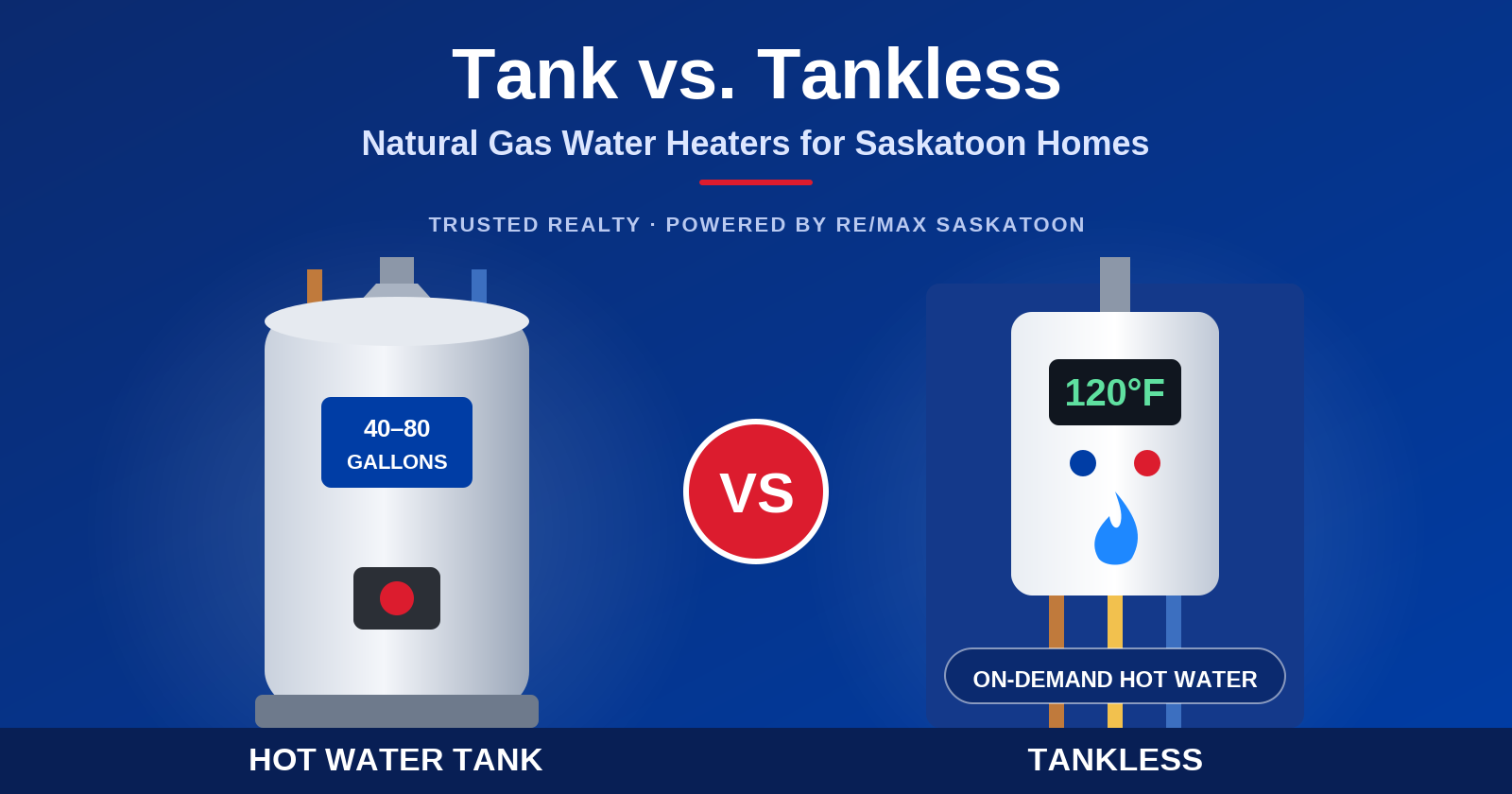
- Traditional natural gas hot water tank: a 40 to 80 gallon tank, usually in the basement mechanical room, with a burner at the bottom that keeps the water at temperature around the clock.
- Tankless (on-demand) natural gas water heater: a compact box mounted on the wall. When you open a hot tap, the burner fires and heats the water as it passes through, so there is no stored supply to run out of.
How Do Tank and Tankless Water Heaters Compare?
Here's the quick side-by-side. A tank wins on upfront cost and simplicity, and a tankless unit wins on efficiency, space and lifespan.
| Natural gas tank | Natural gas tankless | |
|---|---|---|
| Upfront cost | Lower; Saskatoon install labour about $450–$600 | Higher; extra venting and gas line work |
| Hot water supply | Stored, 40–80 gallons | On demand, no storage |
| After heavy use | Must reheat the tank | Keeps going, up to its flow rate |
| Energy use | Keeps water hot all day | About 30% less energy (ENERGY STAR) |
| Typical lifespan | 10–15 years | Up to 20 years or more |
| Space | Needs floor space | Wall-mounted, compact |
| SaskEnergy rebate | Check eligible models | $1,000 on eligible replacements |
Sources: Natural Resources Canada (energy use); Home Depot Canada and FortisBC (lifespans); HomeStars (Saskatoon install labour, 2026); SaskEnergy Residential Equipment Replacement Rebate terms, revised August 17, 2026. Prices and rebates change, so confirm before you buy.
Is a Tankless Water Heater More Expensive?
Yes, upfront. A tank is generally cheaper to buy, and swapping an old tank for a new one is usually simple because the venting and gas line are already in place. HomeStars puts labour for a standard tank install in Saskatoon at roughly $450 to $600, and notes tankless installs run higher because of the extra venting and connection work.
A tankless unit can win back some of that difference over time through lower gas use and a longer life. SaskEnergy's Residential Equipment Replacement Rebate also lists $1,000 for an eligible tankless water heater (ENERGY STAR certified, minimum 0.87 UEF). It applies to replacements, not new construction, the unit must be installed by a licensed gas contractor, and you have 120 days after installation to apply. SaskEnergy notes funding is limited and the program can change, so check saskenergy.com before you buy.
Which Water Heater Uses Less Energy?
Tankless. According to Natural Resources Canada, an ENERGY STAR certified tankless water heater uses about 30% less energy, on average, than a storage tank. A tank keeps reheating the same water even while you're asleep or at work. An ENERGY STAR certified gas tank still helps: NRCan says it saves about 9% compared with a standard gas tank.
Lower hot water use helps with either type. Low-flow showerheads and faucet aerators are two of the easy upgrades in our affordable ways to make your Saskatoon home more energy efficient.
Will a Tankless Water Heater Keep Up With My Family?
Usually, if it's sized properly. A tankless unit never runs out of hot water, but it can only heat so many litres per minute. If two showers, the dishwasher and the washing machine all run at once, an undersized unit can fall behind. Saskatoon's cold winter water makes sizing more important, because the unit has to raise the temperature further in January than in July.
A tank works the other way. It delivers a lot of hot water at once, which is why it's a good fit for larger households, but once the stored supply is used up you wait for it to reheat. Ask a licensed gas contractor to size either option for your household's peak use, not your average day.
How Long Do Natural Gas Water Heaters Last?
A tank typically lasts 10 to 15 years, and a tankless unit can last 20 years or more. Home Depot Canada gives those ranges, and FortisBC puts an ENERGY STAR storage tank at 10 to 13 years. Hard water, skipped maintenance and heavy use can shorten either one, so flushing a tank and descaling a tankless unit as the manufacturer recommends helps.
Signs a tank is near the end include rust-coloured water, rumbling or popping sounds, water around the base and hot water that runs out faster than it used to.
What Should You Check About the Water Heater When Buying a Home?
Its age, its condition and whether it's owned or rented. When you're buying in Saskatoon, the water heater is easy to overlook, but knowing what you're getting helps you plan for future costs and comfort.
- Find the age. The manufacture date is on the label or coded in the serial number, and your home inspector can usually read it. A tank past 10 to 15 years is living on borrowed time.
- Look for warning signs. Rust, corrosion, water stains on the floor, or a missing or damaged vent are worth pointing out to your inspector.
- Ask if it's owned or rented. More on this below.
- Ask about receipts and warranty. A newer unit with paperwork is a plus.
- Tell your insurer. Insurers often ask the water heater's age. See Can You Insure That House? for what else they ask about.
Our printable What to Look For home viewing checklist helps you spot these items at showings, before you get to the inspection.
From our own deals: recently, a home inspection on one of our purchases flagged a hot water tank from 1997, far past its expected life. It still worked, but it could fail at any time. We made sure our buyers had a plan in place to replace it the moment it goes, and because it was an unforeseen issue, we negotiated money off the purchase price to help cover it.
Is the Hot Water Tank Owned or Rented?
Always ask. Most Canadian homeowners own their water heaters, but rentals are common in some provinces, and in our experience rented tanks are becoming more and more common in Saskatoon. A rented water heater belongs to the rental company. The homeowner pays a monthly fee, and the rental agreement often passes to the buyer when the home sells.
Before you remove conditions, find out:
- Is the water heater owned or rented, and who is the rental company?
- What is the monthly fee, and how long does the contract run?
- Is there a buyout price, and what does it cost to end the contract?
- Will the rental be assumed by you, or paid out by the seller before possession?
Rental contracts can run for many years, and some buyers have been surprised to learn how long they agreed to. We'll make sure the answer is clear in your offer. If you're unsure about the contract terms, your lawyer can review it.
Should You Upgrade the Water Heater Before You Sell?
Usually not just for the sale, but you should know its age and have the paperwork ready. Buyers and inspectors will check it, and a tank that's clearly past its life can become a negotiating point, just like the 1997 tank above. If yours is owned, say so. If it's rented, have the contract details ready to share.
Keep installation dates, receipts and warranties in our free Home Records & Warranty Tracker, and see our Saskatoon Home Seller's Guide for what else to prepare before you list.
Water Heater FAQ
Is tankless or tank better for a Saskatoon home?
A tank is the budget-friendly, simple choice and suits households that use a lot of hot water at once. A tankless unit costs more upfront but is more efficient, saves space and lasts longer. Your budget, hot water needs and available space decide it.
Can I switch from a tank to tankless?
Usually, yes, but it often means new venting, and sometimes a larger gas line. Use a licensed gas contractor, who will handle the gas permit through the Technical Safety Authority of Saskatchewan (TSASK).
Does SaskEnergy offer a rebate on water heaters?
Its Residential Equipment Replacement Rebate lists $1,000 for eligible ENERGY STAR tankless and condensing water heaters that replace existing equipment. Check the eligible model list and current terms at saskenergy.com before you buy.
How do I find out how old a water heater is?
Check the label on the unit. The manufacture date is often printed there or coded in the serial number. A home inspector or plumber can decode it for you.
What's a rented hot water tank?
One owned by a rental company, not the homeowner. You pay a monthly fee, and the contract may transfer to you when you buy. Always ask before you remove conditions.
More questions? See our Saskatoon Real Estate Questions & Answers, or look up any unfamiliar listing terms in our Real Estate Glossary. For the full buying process, start with our Saskatoon Home Buyer's Guide.
Buying a Home and Want a Second Set of Eyes?
We'll help you spot the water heater, furnace and other big-ticket items at the showing, and make sure the owned-or-rented question gets answered before you commit. Talk to Clayton and Jessica, your trusted REALTORS®: call or text Jessica at 306.241.6029 or Clayton at 306.341.4401, or browse homes for sale and book a showing.
Sources
Natural Resources Canada, Guide to residential water heaters. SaskEnergy, Residential Equipment Replacement Rebate Program terms (revised August 17, 2026). Home Depot Canada, hot water tank vs. tankless installation. FortisBC, Tank or tankless? HomeStars, water heater installation in Saskatoon. Innovation, Science and Economic Development Canada, Domestic hot water tanks: a consumer perspective. This article is general information, not plumbing, gas or legal advice. Confirm sizing, permits and rebates with a licensed gas contractor and SaskEnergy.